


In this month’s Board Insights, Samantha Bingham brings clean transportation home. In “Making Electric Transportation Work for More Families,” she describes how her family’s needs changed and what it took to make a battery-electric car and a plug-in hybrid minivan work for them. For about a year, that meant relying entirely on public charging, with none of those chargers in her own community.
Her point is not that everyone should make the same choice. It is that cleaner choices must be practical for people whose circumstances differ. She closes with a question worth carrying into every part of IACT’s work: “What will it take to make cleaner transportation work for the people who don’t yet have easy access to it?”
This month, I want to take that question from the household to the fleet yard. The decisions are different, but the practical test is familiar: does the vehicle fit the job, can it be fueled reliably, and do the costs work over time?
Renewable natural gas, or RNG, offers one way to explore that test. It also brings us back to this column’s Illinois questions: who makes the fuel, who does it employ, and where do the dollars land? Producing a fuel here is only part of the opportunity. Making it a workable choice for Illinois fleets is the next step.
Diesel’s Price Surge Puts Fleet Fuel Strategy Under the Microscope
For the week ending September 14, on-highway diesel averaged $6.285 a gallon nationally, the first time in history the national average topped six dollars. That is about 65% above the $3.81 recorded in the last weekly reading before the military action that began February 28.

Notice the asymmetry. Over exactly the same span, regular gasoline rose from $2.94 to $4.32—about 47%. Painful, but eighteen points shy of diesel’s 65%, and that gap is the part that matters to freight. This is a refining story layered on a supply story. EIA attributes the disruption to the de facto closure of the Strait of Hormuz—a transit chokepoint through which nearly 20% of global oil supply flowed beforehand—with attacks on Russian refineries tightening distillate further and U.S. refineries already running near capacity with little slack to absorb it. Reuters has reported that the result pushed global refining to the brink, with elevated diesel potentially persisting for years. And diesel is the bigger economic risk precisely because it runs through trucking, fuel surcharges, and prices across the whole economy.
Those prices give fleets a reason to reconsider their options. They do not, by themselves, establish a business case for replacing equipment. A decision that must work for years needs to account for changing fuel prices, vehicle availability, fueling access, and the work the truck actually performs.
Fuel Diversification Can Reduce Exposure to Diesel Volatility
The real product a shipper buys is not cheap transportation. It is predictable transportation. And the real damage diesel volatility does is not that fuel is expensive. It is that fuel is unbudgetable.
Consider the mechanics. A carrier’s contracted linehaul rate is typically quoted excluding fuel, with fuel moving separately through a surcharge pegged to a published diesel index, a structure designed to keep base rates stable while covering actual fuel spend. That works beautifully when diesel is boring. When diesel is not boring, the surcharge becomes the channel through which a supply disruption eight thousand miles away reaches a shipper’s landed cost in the middle of a contract they already signed and already budgeted.
The rate environment on top of it is whipsawing too. Spot rates ran above contract in June and July, then in August the national van spot rate fell 20 cents to $2.19 a mile, the steepest August pullback on record, dropping back below contract. Neither side of that market offers a stable number to plan against.
Then there is this. EIA currently forecasts retail diesel averaging $5.07 in 2026 and $4.40 in 2027, a decline from today. But both figures are revisions upward from the $4.85 and $4.07 the agency had published one month earlier, in its August outlook—increases of 4.4% and 8.2% driven by depleted inventories and tight global supply.
Even the federal government’s forecast of the decline keeps moving. If the best-resourced energy forecaster in the world cannot hold a diesel number for thirty days, no fleet manager should be expected to price a three-year dedicated contract against one.
This is where fuel choice stops being an environmental decision and becomes a risk management decision. RNG is priced off domestic natural gas, not global crude—a different commodity, a different supply chain, and a feedstock that is literally Illinois garbage. Hormuz moved oil. It did not meaningfully move Henry Hub, the Louisiana pipeline interchange whose spot price is the U.S. natural gas benchmark, much as Brent is for crude. Henry Hub sits near $2.80 per MMBtu today, roughly where it stood in April.
One honest qualification, because our members will push on this and they should. Decoupled from oil does not mean stable. Henry Hub averaged $7.72 in January of this year before falling to today’s level—natural gas carries its own volatility, driven mostly by winter weather rather than geopolitics. And growing U.S. LNG exports are slowly tying domestic gas prices to global demand, a trend worth watching over the five-year horizon in which a fleet actually owns a truck.
The argument, then, is not that RNG guarantees predictable prices. It is that a fleet should evaluate whether fuel diversification can reduce its dependence on a single market. That is a question to test against actual fuel contracts and operating costs, not a claim that different energy markets are unrelated or that adding another fuel eliminates risk.
Samantha describes how electrifying much of her family’s everyday driving has reduced their exposure to gasoline-price fluctuations. For fleets, the comparable question is which vehicles and routes could use a different energy source without compromising service. Diversification only helps when the equipment, fueling arrangements, and economics work together.
RNG Turns Waste Into a Transportation Fuel
If you have spent time in clean transportation, you have learned to be skeptical when someone hands you a natural gas brochure. Natural gas is a fossil fuel, and a coalition like ours has to be careful.
So consider this: 94% of all on-road fuel used in natural gas vehicles in the United States in 2025 was renewable—755 million of 806 million gasoline-gallon-equivalents, up 13% over 2024 and up 94% since 2021. When a truck in America runs on natural gas today, it is almost certainly running on captured landfill methane, dairy manure, wastewater solids, and food waste. Over 2025 that displaced 11.01 million metric tons of CO2 equivalent, and California’s bio-CNG portfolio posted a negative average carbon intensity for the sixth consecutive year.
RNG is the only fuel in our portfolio whose feedstock is currently a liability. Every other fuel starts with something we grow, refine, or generate. This one starts with something Illinois communities already pay to dispose of.
The 15-Liter Engine Changes the Natural Gas Freight Equation
For fifteen years, natural gas in trucking had a hard ceiling: engines topped out around 12 liters, which worked for refuse and transit and not at all for heavy freight. Cummins’ 15-liter X15N, launched in 2024, removed that ceiling. It is offered by Freightliner, Peterbilt, and Kenworth, delivers roughly 800 miles of day-cab range and 1,200-plus in a sleeper, and fleets including J.B. Hunt, FedEx Freight, and Midwest Logistics Systems have described natural gas reaching cost parity with diesel.
On September 14, 2026, Energy Vision published an update to its report A Path to a Healthier America: Ditching Old Diesel Trucks, re-running its economics against this year’s prices. Because renewable diesel is priced near parity with petroleum diesel, RD rose right along with it; RNG did not. Energy Vision puts the resulting gap at about $2 per diesel gallon equivalent nationally, $3.50 in California. Against a roughly $75,000 capital premium for a new natural gas tractor, that produces payback of 1.3 years at 100,000 annual miles and the wider spread, stretching to 2.8 years at 80,000 miles and the narrower one.
Read those caveats carefully, because they matter more than the headline:
- These are fuel-savings estimates, not total cost of ownership. They exclude financing, maintenance, fueling infrastructure, and residual value — and they assume the price gap persists. That is exactly the assumption I just argued fleets should not make. Anchor a business case to the decoupling; treat today’s spread as upside, not as an input.
- Utilization moves the answer by a full year. Same truck, same spread. That is match-the-fuel-to-the-mission showing up inside a spreadsheet, and it is why I decline to give members a single number.
- The engine exists; the supply chain barely does. Slightly more than 1,000 X15N trucks were operating as of July 2026. The report’s own scenario needs about 65,000 tractors and concedes manufacturers cannot currently supply them, though Cummins projects 20,000–25,000 units a year by 2030. That is an argument for getting in the queue early, not an argument that the queue is short.
- Energy Vision is a methane-focused environmental nonprofit, and its lead author calls RNG the “most cost-effective, feasible, commercially available” option examined. That is his conclusion, not ours. The study is also scoped to pre-2013 trucks in 31 dense counties — a narrower and more defensible claim than “best fuel for freight.”
IACT does not rank fuels. What the update usefully shows is that the ordering moves when input prices move — a good reason for members to re-run their own numbers this fall rather than trust a spreadsheet built when diesel was $3.81.
Who Makes RNG in Illinois
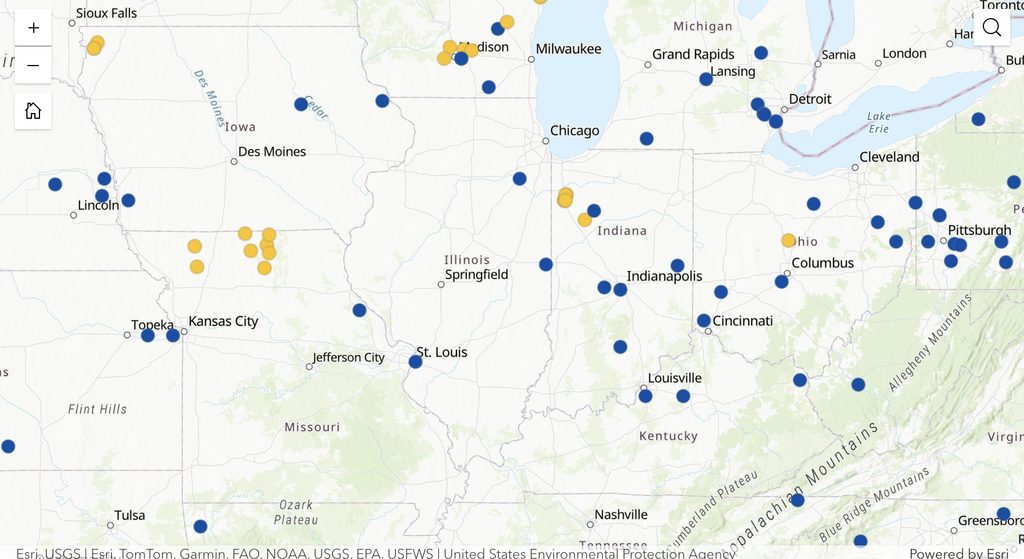
Illinois has quietly become a serious RNG-producing state, and the production sits in exactly the communities usually left out of these conversations:
- Rockford (Winnebago County): Air Liquide’s Winnebago Landfill plant, the company’s largest RNG facility in the world, roughly 1.3 million MMBtu a year, online June 2024 as Nicor Gas’s first biogas interconnection under an ICC pilot approved in 2021.
- East Moline (Rock Island County): Upper Rock Island County Landfill, commercial operation December 2025.
- Danville (Vermilion County): Brickyard Landfill, operating since September 2024, about 460,000 MMBtu a year.
- Grayslake (Lake County): Countryside Landfill, a $30 million build injecting roughly 2,100 MMBtu a day.
- Edwardsville (Madison County): Ameresco and Republic Services’ 15.6 MW facility at the Roxana Landfill.
Five regions: Rockford, the Quad Cities, east-central Illinois, the collar counties, and the Metro East. The dollars land where the waste is, which is to say everywhere. Amp Americas, a Chicago-headquartered dairy-RNG developer, adds a second layer, though its projects are largely in Indiana, Wisconsin, and Minnesota. We host the company and export the expertise.
Illinois Has the Feedstock and Pipelines, But It Needs the Fueling Network
Illinois has 12 public CNG stations. Seventeen more are private. The state recorded 300 CNG vehicle registrations in 2025, against 490 public biodiesel locations, 89 propane locations, and more than 6,000 electric charging ports.
Nationally, the Energy Vision update reports roughly 1,400 CNG stations as of August 2026, 767 of them dispensing RNG, up from 527 in January 2025. For an individual fleet, however, a national count cannot answer the local question: is suitable fueling available where its trucks operate?
The Illinois production facilities described above are a starting point, not a complete fueling solution. A fleet still needs to evaluate station access, capacity, reliability, and whether its fuel agreement actually supplies RNG. Matching fleet demand with suitable infrastructure is a coordination task in which a coalition can help.
This is where Samantha’s experience provides a useful parallel without making the two situations identical. She had the knowledge and commitment to manage public charging without a charger in her own community, but she rightly asks whether every family should be expected to overcome that barrier. We should apply the same practical test to fleets: a promising technology should not require an operating plan built around inconvenient workarounds.
A return-to-base fleet may be able to build its plan around a depot or nearby station. A fleet with changing routes needs to examine range, detours, backup fueling, and access along those routes. Neither a statewide station count nor a favorable fuel-price comparison replaces that work.
Save the Date: Fueling Illinois’ Freight Futures
Thursday, February 25, 2027, at the Autobahn Country Club in Joliet.
We chose Joliet deliberately. Will County is the largest inland port in North America, moving more than 3 million containers and over $65 billion in goods annually across two intermodal centers, six Class I railroads, and more than 100 million square feet of industrial space — with truck miles projected up 57% by 2050 and some interstates already carrying 9,000 trucks a day.
For drayage operations with predictable routes and trucks returning to a common yard, natural gas is one option worth evaluating alongside other fuels and technologies. Public CNG stations are listed in Joliet, Romeoville, Mokena, and Bolingbrook, so this is not a conversation starting from an absence of local infrastructure.
The useful question is what that infrastructure can support, where additional access would matter, and which fleets have the right operating profile. Bringing those questions to Joliet makes the summit a place to compare practical requirements, not simply promote equipment.
The summit’s purpose is to help participants match cleaner transportation options to their operations, not to select a winning fuel. Our technology-neutral approach brings liquid fuels, gaseous fuels, electricity, and hydrogen into the conversation. The program is also being developed to address warehouse operations and corridor planning, with outdoor demonstrations connecting those discussions to equipment.
On the gaseous fuels track we are working on sessions covering the 15-liter platform, station economics for return-to-base and drayage fleets, utility interconnection and the ICC pilot pathway, and the Illinois RNG producers themselves, so Will County fleets can meet the people capturing methane in Rockford, Danville, and East Moline.
Sponsorships, agenda input, speaker proposals, and host-fleet nominations are open now.
Match the Fuel to the Mission, Not Just the Price Tag
- Evaluate diversification, not just today’s price spread. Consider whether another fuel can reduce concentrated exposure while meeting service requirements. Do not mistake a different source of price risk for an absence of risk.
- The fuel is already overwhelmingly renewable. At 94% of on-road natural gas volume, the question is not whether CNG is a fossil pathway. It is whether Illinois participates in the waste-to-fuel pathway it already supplies.
- Production and access are different questions. Illinois’ RNG facilities create an opportunity, but fleets need workable fueling arrangements to participate.
- The engine constraint eased; the supply constraint did not. About a thousand X15N trucks exist today. Early movers get in a real queue.
- There is no single right choice for every operator. Evaluate RNG alongside other options, using the actual route, vehicle, fueling arrangements, and ownership costs. That is what matching the fuel to the mission requires.
A genuine thank-you to Samantha Bingham for grounding this month’s Board Insights in everyday experience. Her column reminds us that cleaner transportation must work for people as their needs change, not only for those with the easiest access or the most technical knowledge.
For IACT, that means helping turn available technologies into usable choices, whether the decision is being made at a kitchen table or in a fleet office. The freight summit is an opportunity to do that work together.
Match the fuel to the mission. Then make sure the people carrying out that mission can actually use it.
See you on the road,
Ann Schneider
Board Chair, Illinois Alliance for Clean Transportation

Dr. Ann Schneider became IACT’s chair in 2026, bringing 36 years of professional experience in public finance, public policy, and solutions development and 18 years of executive-level transportation policy experience to the role. Now a transportation policy consultant, Dr. Schneider has helped clients secure nearly $357 million in grant funding.