

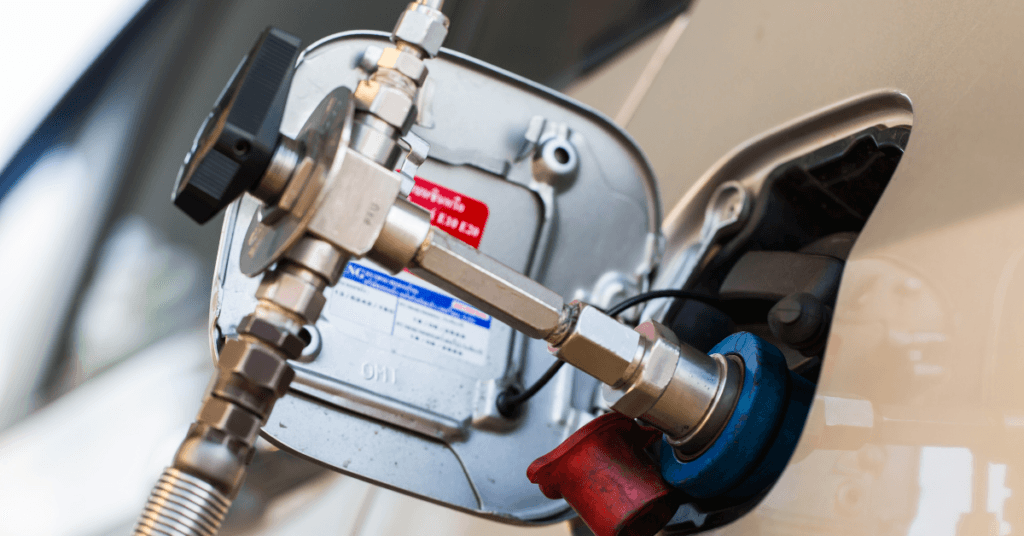
Did you know that natural gas has been a staple fuel for fleet operations for many years? Even so, only 0.2% of U.S. natural gas production is used for transportation fuel. Natural gas is considered fossil fuel. Eons ago solar energy was captured by plants and stored by geological forces as natural gas, liquid petroleum, and/or solid coal. Recently, renewable natural gas (RNG) has come on the market. It is made from recent plant and animal products, and often waste. And is not considered a fossil fuel. It also does not contribute to greenhouse gas increases.
This is one of a series of articles on alternate sources of energy for transportation. Its purpose is to condense information on this topic for the fleet manager and general user.
In a previous article, gaseous fuels such as ammonia and hydrogen were discussed as potential fuels of the future that depend on new engine technologies and distribution chains. RNG is a fuel that is chemically the same as natural gas. It usable now as a drop-in substitute for natural gas in engines and is totally compatible with the existing natural gas distribution system.
Natural gas is mostly methane (CH4), a chemical with one carbon atom and four hydrogen atoms. The chemical energy is stored in the carbon-to-hydrogen bonds. When a methane molecule is combusted to carbon dioxide (CO2), we get four units of energy, one for each set of bonds. With other hydrocarbons, one or more of the bonding sites on each carbon is a carbonto-carbon bond. This means we get less energy for each molecule of carbon dioxide created. So even fossil fuel methane results in lower greenhouse emissions for the energy obtained than other fossil fuels. Light-duty vehicles can provide greenhouse gas emissions reductions of 15% according to Argonne National Laboratory’s GREET model, just by using conventional natural gas vs. other petroleum fuels.
RNG is manufactured using biological processes like anaerobic digestion or thermochemical treatments. Consequently, it is often called biomethane. The feedstock can be virgin plant material or residues from food processing, landfills, or livestock waste. Living plants take carbon dioxide from the air using sunlight. When plants are then used to make RNG and it is subsequently used as fuel, the carbon is recycled and does not contribute to greenhouse gas
increases.
Methane/biomethane itself is not toxic. Burning it in an engine does result in carbon monoxide, nitrogen oxides and particulate matter. However, it burns cleaner than gasoline or diesel. When used in vehicle engines with the required emissions controls it results in low emissions.
The gas is compressed to be stored in tanks at 3,000 to 3,600 psi for light-duty vehicle use. In this form it is known as compressed natural gas or CNG. Gasoline and diesel fuel are more energy dense, so they have longer range than CNG vehicles with the same size tank. Heavy duty vehicles (long range trucks, marine, and railroad applications) that need longer range have used LNG or liquified natural gas. It is liquified by cooling below its cryogenic boiling point at about – 260 degrees F and stored in specially insulated tanks. LNG is also the form used for bulk marine shipping and then converted to CNG for use.
There are more than 175,000 vehicles using natural gas in the U. S. today according to NVG America. The same source says there are more than 1,600 total CNG fueling stations and 140 LNG stations. Only about half of these are public fueling stations according to U.S. Department of Energy (DOE) data.
According to DOE in 2021 there were 230 RNG production projects in the U.S. with a capacity to produce a total of 574 million diesel gallon equivalents for transportation. Almost ¾ of that RNG was from landfill projects. This means that only about 0.3% of U.S. natural gas transportation
use is RNG at this time.
Engines designed to use NG/RNG have different fuel metering, computer modules, and in the case of LNG, evaporator modules. Typically, these are designed to run on only NG/RNG. There are some bi-fuel vehicles that have two separate fueling systems that enable them to run on NG/RNG or gasoline. Other dual-fuel vehicles are designed with diesel fuel for ignition assistance, but their normal operation is powered by NG/RNG.
Alternative fuel choices and availability are changing frequently. Stay tuned for updates.

James “Jim” O’Brien was elected to the IACT board in 2026 and serves as Treasurer. With degrees in chemistry and business administration, he brings extensive expertise in fuel chemistry, chemical safety, hazard assessment, and emergency management. After 20 years with the Illinois EPA leading emergency response, prevention, occupational safety, and toxics risk assessment efforts, he became an environmental consultant.