

Most of the clean-transportation conversation happens at ground level—trucks, buses, and cars. But some of the hardest emissions to eliminate are the ones that leave the ground. You cannot put a battery big enough to cross an ocean on a commercial jet, and you will not be able to anytime soon. For aviation, the most practical path to lower emissions available today is the fuel itself, and Illinois has put itself squarely in the middle of getting it into the air.
This Featured Fleet looks skyward at United Airlines, which operates one of the largest hubs in the world at Chicago O’Hare, and the sustainable aviation fuel, or SAF, that is beginning to power flights there.
The fuel itself is produced at Phillips 66’s Rodeo Renewable Energy Complex in California, made from waste and residue feedstocks—used cooking oil, tallow, and distillers corn oil—rather than fossil crude. From there it is shipped to Illinois and blended with conventional jet fuel at the company’s Wood River Refinery in Roxana, in Illinois’ Metro East, then moved to O’Hare by pipeline.
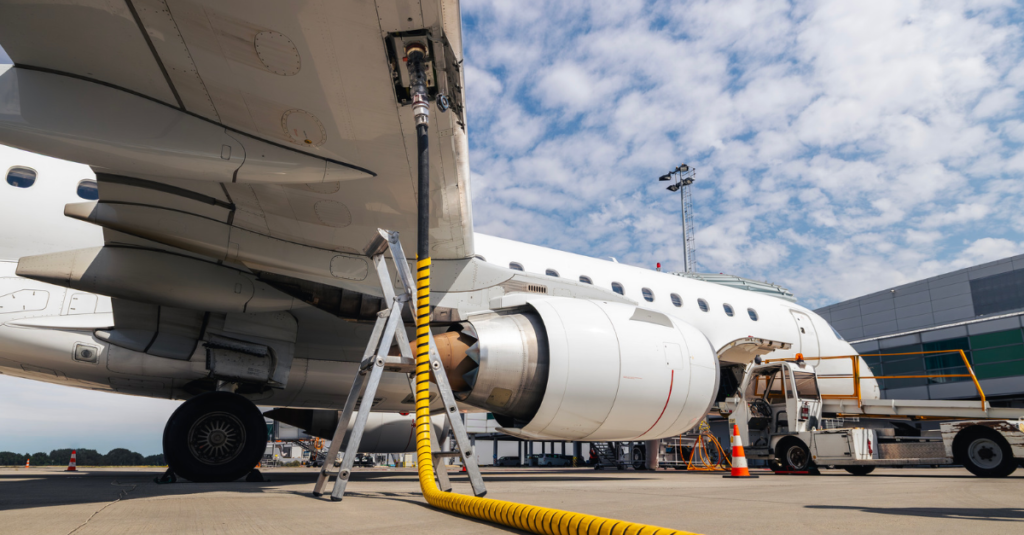
That blending-and-supply role is the point: SAF is a drop-in fuel, chemically close enough to conventional jet fuel that it rides the same pipelines, powers the same engines, and needs no change to the aircraft or the airport’s fueling systems. The effort recently passed an 11-million-gallon milestone delivered to O’Hare, where United became the first airline to purchase SAF for use. State officials have said the fuel supplied so far is enough to offset the emissions of roughly 800,000 passenger trips departing O’Hare in a single year.
For a fleet manager, that drop-in quality is the whole point. SAF is to a jet what a biodiesel blend is to a diesel truck: a cleaner fuel that works within the equipment and infrastructure you already own. There is no fleet to replace and no new fueling system to build. The challenge is not the technology; it is supply and price. SAF still costs more than conventional jet fuel and is produced in far smaller volumes, and that is precisely where Illinois has stepped in.
Illinois became the first state in the nation to create a tax credit specifically for sustainable aviation fuel: a purchase incentive of $1.50 per gallon, created in 2023, for qualifying SAF bought for use by an airline in Illinois. Importantly, the credit applies to SAF used in the state regardless of where it is produced, which is what lets California-made fuel pencil out when it is bought and burned at O’Hare. Paired with the Invest in Illinois Act, that credit helped assemble an unusual coalition: Phillips 66 supplying the fuel, United buying and flying it, Microsoft adding corporate demand, and the state closing the economics.
What makes this an Illinois story is less about where the molecules are made than about what Illinois did to put them in the air. The state wrote the first SAF purchase credit in the country; its Metro East refining and pipeline infrastructure blends and moves the fuel to O’Hare; and United is flying it from the busiest airport in the Midwest. Governor JB Pritzker, who marked the milestone at the Wood River refinery, framed SAF as a way to connect Illinois’ agricultural and industrial strengths with the aviation sector’s growing demand for cleaner fuel.
At IACT we often make the point that there is no single answer to cleaner transportation—the right tool depends on the job. Aviation is one of the toughest jobs of all, and for now, sustainable aviation fuel is the tool that fits. That Illinois helped build the market for it — and is flying on the result — is a story worth telling, and worth watching as production scales and the volumes grow.

Dr. Ann Schneider became IACT’s chair in 2026, bringing 36 years of professional experience in public finance, public policy, and solutions development and 18 years of executive-level transportation policy experience to the role. Now a transportation policy consultant, Dr. Schneider has helped clients secure nearly $357 million in grant funding.