

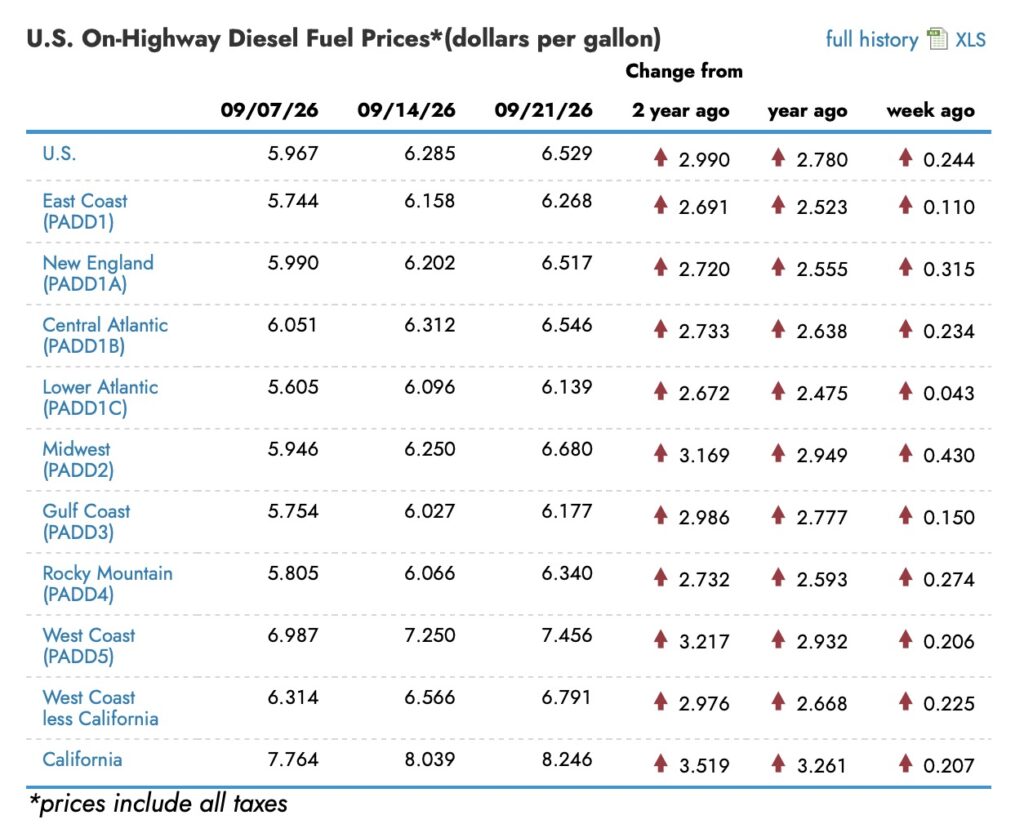
If you run trucks in Illinois, you didn’t need a headline to tell you what happened this month, you saw it at the pump. In the week of September 21, on-highway diesel across the Midwest averaged $6.68 a gallon, higher than the $6.53 national figure making news and up more than forty cents in a single week. Nationally, that average now sits nearly $2.80 above where it was a year ago. These are the U.S. Energy Information Administration’s weekly retail prices, and the Midwest number is the one that matters for us, this fall it is running ahead of the country as a whole.
A jump like that doesn’t land on everyone the same way. Carriers with fuel-surcharge provisions written into their contracts can pass much of the increase along to their customers. The operators who feel it first and hardest are the smaller ones and those exposed to the spot market, where it can take weeks for rates to catch up to the cost of the fuel already burned. And the timing is its own kind of cruelty: this spike arrives just as Illinois’ harvest moves into full swing and our grain and agricultural haulers are running hardest.
I want to make an observation that has nothing to do with any one fuel. How badly a week like this hurts your operation is, in large part, a measure of how much of your energy comes from a single, globally priced commodity. When all of it does, a decision made on the other side of the world shows up on your fuel bill and in your margins within days. The less of your energy that rides on that one number, the steadier your costs, and the easier it is to plan, bid, and stay in business through a bad month.
That is the whole reason IACT talks about fuel choices as economic decisions rather than environmental ones. The clean-fuels landscape is shifting quickly as federal and state policy changes, and our role is not to sell anyone a particular technology—it is to help fleets make sound economic choices about what fits their routes, their duty cycles, and their budgets.
For most fleets, the first and safest of those choices is efficiency. Idle reduction, telematics, better aerodynamics, and right-sizing a truck to its job cut fuel use no matter what is in the tank, which means they pay off whether diesel is three dollars or nearly seven. From there, Illinois is unusually well positioned. We grow, refine, and generate a range of home-grown options—biodiesel and renewable diesel, where a B20 blend is a sensible place to start, along with renewable natural gas, propane, and electricity and the EV supply chain—each of which reduces a fleet’s exposure to diesel to a different degree for a different kind of work. None is right for every operation. Together, they are how a fleet stops being a passenger to one price.
There is a useful outside voice on this. In its recent Maritime Forecast 2050, the classification society DNV called improving energy efficiency one of the rare moves that creates value under almost any future scenario, a hedge that pays back whether prices rise or fall and whichever fuels ultimately win out. DNV was writing about ships, but the logic is identical for a truck on I-55 or a towboat on the Illinois River: in a world where energy markets and rules can change overnight, resilience is worth building now.
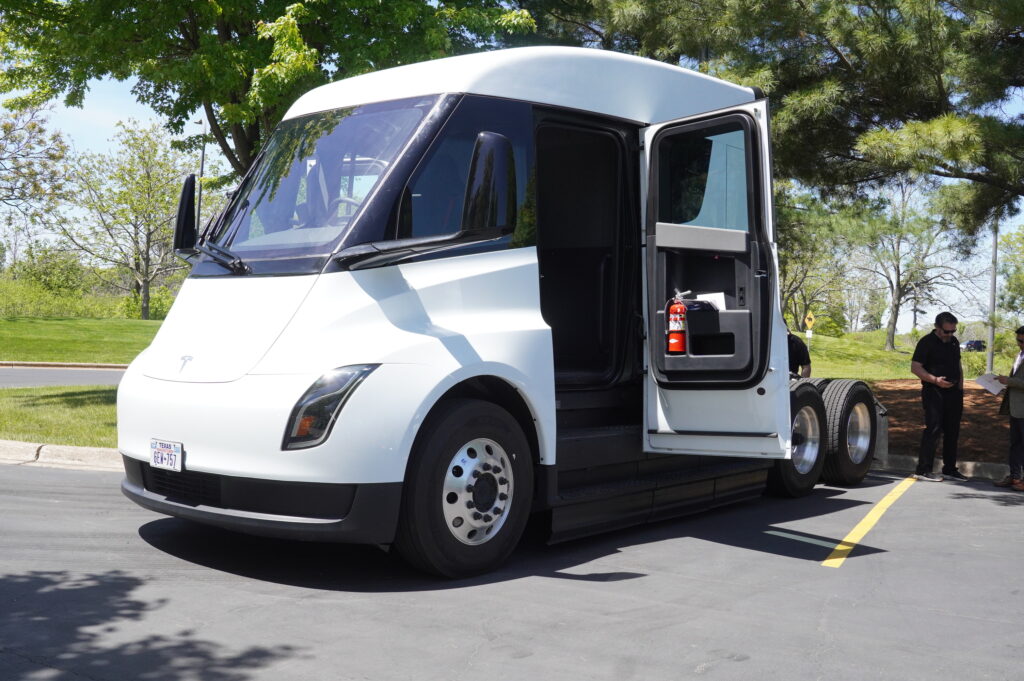
This isn’t only theory, and it isn’t far from home. IMC Logistics—one of the country’s largest intermodal drayage carriers, which runs container drayage right here at the Joliet-Elwood inland port—is pursuing a deliberately blended fuel strategy across its network, operating battery-electric, hydrogen fuel-cell, and renewable-diesel trucks rather than betting on any one of them. It is now adding dozens more electric trucks in its West Coast operations, assigning shorter-range units to port drayage and longer-range units to inland lanes. Jim Gillis, the carrier’s Pacific regional president, describes the approach simply as “a blended approach rather than relying on a single technology.” The West Coast specifics reflect California’s conditions, not ours, but this is a carrier that already moves freight through our own inland port, applying exactly the logic an Illinois fleet manager can use: match the tool to the duty cycle, and don’t let a single fuel set your whole cost structure.
That is exactly the conversation we are convening at Fueling Illinois’ Freight Future on February 25, 2027, in Joliet—a day where Illinois fleets can put these options side by side and see the numbers for their own operations. I hope you will join us. A month like this one is the best argument I can make for why it matters.

Dr. Ann Schneider became IACT’s chair in 2026, bringing 36 years of professional experience in public finance, public policy, and solutions development and 18 years of executive-level transportation policy experience to the role. Now a transportation policy consultant, Dr. Schneider has helped clients secure nearly $357 million in grant funding.