


Freight is where much of Illinois moves, and it is where many of the hardest clean-transportation questions live. So it is worth noting when a practical answer shows up already at work—not in a pilot or a someday, but on real lanes, hauling everyday freight, running through Chicago right now.
That is what a deployment profiled this month by IACT News offers. Paper Transport, a Wisconsin-based carrier, is running eight heavy-duty trucks on renewable natural gas for Graphic Packaging International, moving the company’s paperboard and packaging freight on dedicated lanes between Chicago, Illinois, and Kalamazoo, Michigan. The trucks are powered by Cummins’ X15N natural gas engine and fueled with renewable natural gas supplied by Clean Energy. After about a year in service, the partnership is a working example of how an alternative fuel can carry real freight day in and day out.

Renewable natural gas, or RNG, is pipeline-quality fuel captured from organic waste—landfills, dairy and farm digesters, and wastewater treatment—and upgraded to run in the same engines as conventional natural gas. Burned in a natural gas truck, RNG can deliver up to 90 percent lower lifecycle greenhouse gas emissions than diesel, and some production pathways reach a negative carbon intensity. Those are the fuel’s potential ranges rather than measured results for this particular fleet, but the direction is the point: for Graphic Packaging, the deployment is one way to address the Scope 3, or supply-chain, emissions that freight represents for a shipper.
What makes the example compelling is how little the fleet appears to give up. Tom Driscoll, senior vice president at Clean Energy, described pairing RNG with the Cummins X15N as delivering diesel-comparable performance and range on, in his words, “a fuel that costs less than diesel.” The X15N is a 15-liter engine built for exactly this kind of heavy, long-day duty, the class of work where operators have historically been most skeptical that anything but diesel could keep up.
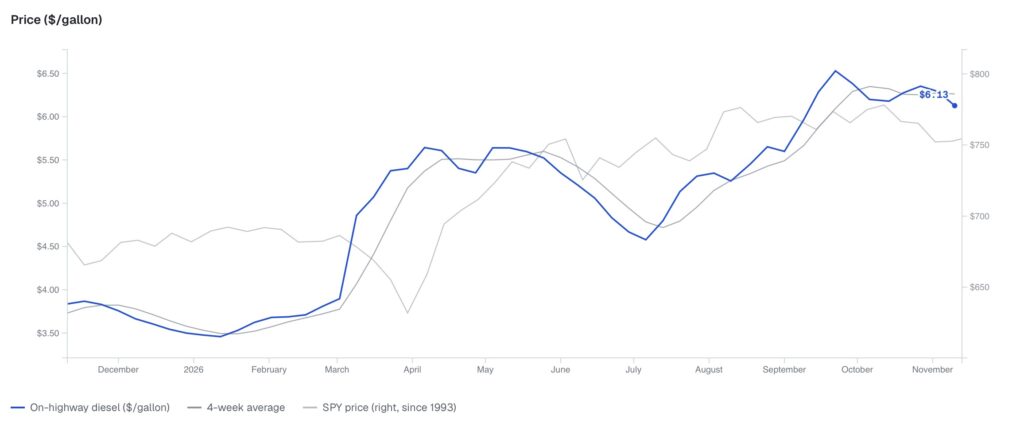
The economics are hard to ignore this fall. On-highway diesel averaged $6.13 a gallon the week of November 9—more than $2 above where it stood a year earlier—which sharpens the case for any fuel that can come in lower. Tyler Ellison, CEO of Paper Transport, framed the collaboration as supporting Graphic Packaging’s sustainability goals “without sacrificing performance or reliability.”
Paper Transport is not experimenting at the margins. The carrier put its first natural gas fleet on the road in 2010 and has since logged more than 87 million natural gas miles, a depth of operating history that matters when a shipper is weighing whether to trust a fuel with its freight. Domingo Amunategui, vice president of logistics at Graphic Packaging, said the partnership has shown the company how to add an alternative fuel to its freight operations while keeping “the service and reliability our business and customers expect.”
For Illinois, the detail that stands out is the geography. These are dedicated, return-to-base-style lanes anchored in Chicago: predictable routes, known fueling, heavy loads. That is precisely the duty cycle where natural gas and RNG tend to fit best, and it is a reminder that the map of cleaner freight is already being drawn through Illinois, not around it.
At IACT, we talk often about matching the right clean-transportation technology to the right job. No single fuel is the answer for every fleet or every route — but for a great deal of heavy freight running fixed, high-mileage lanes, a modern natural gas engine on renewable fuel is one of the real options on the table today. Examples like this one are exactly the kind of practical, technology-neutral evidence we want fleets comparing as they weigh their own next moves.

Dr. Ann Schneider became IACT’s chair in 2026, bringing 36 years of professional experience in public finance, public policy, and solutions development and 18 years of executive-level transportation policy experience to the role. Now a transportation policy consultant, Dr. Schneider has helped clients secure nearly $357 million in grant funding.