


The Quietest Clean Transportation Story in Illinois Is Happening at the Airport
Two things are about to happen in Illinois that most clean transportation advocates are not tracking.
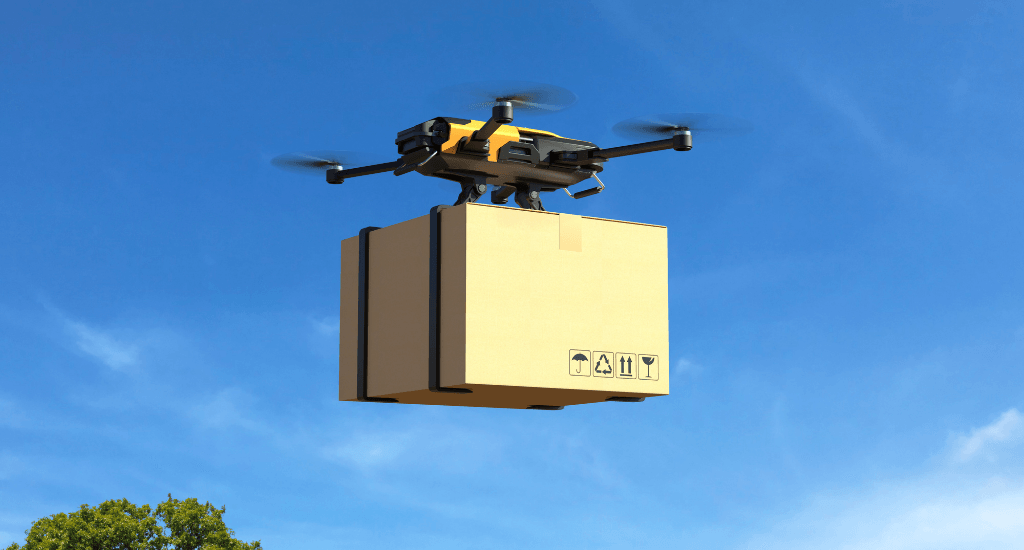
In the south suburbs, Amazon is setting up drone delivery hubs in Markham and Matteson, with roughly 15 aircraft per site, flying packages up to five pounds to customers within about eight miles. Amazon told the Chicago Tribune it was targeting early summer, pending final Federal Aviation Administration (FAA) approvals and local permits. Federal environmental review documents show the company has actually asked to operate at four Illinois locations: Markham, Matteson, Morton Grove, and West Chicago.
Two hundred miles south, Abraham Lincoln Capital Airport in Springfield has quietly become nearly 100% electrified with renewable power, running on two on-airport solar arrays totaling roughly 4.5 MW, and is now designing the battery storage it will need to charge aircraft.
Neither of these is an air taxi. Both of them are Advanced Air Mobility—and both are, at their core, energy infrastructure projects. That is why they belong in this newsletter.
What is Advanced Air Mobility?
Advanced Air Mobility (AAM) describes a class of highly automated, electrically powered aircraft capable of vertical takeoff and landing. As a recent TR News feature on preparing airports and communities for AAM lays out, the realistic near-term use cases are four: air metro (short urban and regional passenger hops), air cargo including last-mile parcel delivery, air medical transport, and emergency response.
One clarification worth making up front: AAM is not synonymous with battery-electric aviation, and this article should not be read as suggesting it is. Aviation’s broader energy transition remains genuinely multi-fuel; sustainable aviation fuel, hydrogen propulsion, and hybrid-electric powertrains are all in active development, and an airport’s energy plan has to account for the liquid fuels its existing fleet will burn for decades. The AAM segment happens to be electric-first because the aircraft are small and the missions are short. That is a mission-matching outcome, not a fuel preference.
Notably, the passenger air taxi—the rendering that has dominated a decade of investor decks—is the most difficult of the four, not the easiest.
When the FAA announced the eight projects selected for its new eVTOL Integration Pilot Program in March, five of the eight were cargo-first: medical logistics, offshore energy supply, autonomous freight, and rural delivery.
U.S. eVTOL Certification and BVLOS Delays Put Illinois Air Taxi Infrastructure at a Crossroads
IACT’s standing position is that we do not sell technologies before they are ready. So here is the unvarnished picture.
No U.S. eVTOL aircraft has received FAA type certification. Both leading programs are in the final stage of the process, and neither has finished it.
The milestone to watch is Type Inspection Authorization, or TIA. TIA is the point at which the FAA authorizes its own test pilots to fly the aircraft and the resulting flights count “for credit” toward certification, rather than being the manufacturer’s own developmental data. It is the last major evidentiary step before a Type Certificate, and it requires an aircraft built exactly to the FAA-approved design—a “conforming” aircraft, not a prototype.
Joby Aviation began flying its first FAA-conforming aircraft in March, a necessary precursor to TIA, with FAA pilots expected to take the controls for for-credit testing later this year. Archer Aviation, whose Midnight is the aircraft associated with the proposed Chicago route, reported in May that it had become the first eVTOL company to close Phase 3 of the FAA’s four-phase type certification program and is now working through Phase 4, the formal testing and analysis phase that includes TIA. Archer has said it expects initial U.S. operations this year; the original 2025 target for O’Hare service has already passed.
The BVLOS rule is still not final. Part 108, the regulation that would normalize routine beyond-visual-line-of-sight drone operations without case-by-case waivers, was published as a proposed rule on August 7, 2025, with comments closing that October. Despite a good deal of confident reporting to the contrary, it has not been finalized. The final rule arrived at the White House Office of Information and Regulatory Affairs for review on July 10, 2026, where the Office of Information and Regulatory Affairs (OIRA) has a nominal 90-day window. Until it publishes and its compliance date passes, operators still work through Part 107 waivers, Part 135 certificates, and Section 44807 exemptions.
The capital burn has been substantial and the revenue has not arrived. Treat any specific commercial launch date you hear this year with skepticism.
What is not speculative is the ground infrastructure., and that is where Illinois has real decisions to make in the next 24 months.
Why This is a Clean Transportation Story
Here is what should get every IACT member’s attention. Research from the National Laboratory of the Rockies, the Department of Energy (DOE) lab previously known as the National Renewable Energy Laboratory until December 2025, and the FAA found that a working vertiport needs 1 megawatt or more of charging capacity, roughly the instantaneous demand of 800 homes. Adding that load increased site electrical demand by six to seven times in most cases. Every single site the researchers modeled required local grid upgrades, including transformers, distribution lines, voltage regulators, and protection equipment.

If that sounds familiar, it should. It is the same conversation we had in this space about the Megawatt Charging System and Illinois freight corridors: the same interconnection queues, the same substation constraints, and the same multi-year utility lead times. AAM is not a separate energy problem. It is the same problem, arriving at airports.
Three consequences follow:
1. The Charging Hardware is Converging on a Multimodal Standard
The General Aviation Manufacturers Association (GAMA) standard on the Combined Charging Standard, and most electric aircraft developers have followed, as it’s the same connector already used by on-road electric vehicles. Equipment now reaching the market reflects that: BETA Technologies’ Charge Cube, cited here as one illustration rather than a recommendation, delivers 320 kW over CCS, is UL-certified, and serves both electric aircraft and ground vehicles from the same unit (BETA Technologies). In July, Archer, BETA, and Macquarie Capital announced ACES, a consortium to build interoperable charging at more than 250 aviation sites by 2030.
The practical implication for an Illinois airport, county, or fleet operator is a sequencing question rather than a purchasing one. Ground fleet and ground support equipment electrification can be evaluated on its own merits, on its own payback period, with the aircraft-readiness of the hardware as a secondary consideration. Springfield sequenced it that way: the airport’s first step is installing ground vehicle chargers, putting initial infrastructure in place, then adding aircraft chargers as demand materializes. Whether that sequence pencils out is a site-by-site analysis, not a general rule.
2. Battery Energy Storage is the Key to Electrification
Susan Zellers, who led the two-and-a-half-year electrification study Hanson Professional Services conducted for Springfield, put the constraint plainly: “You’re just not going to be able to pull it off the grid in that amount of time.” The study’s central recommendation was battery energy storage: charge the BESS during off-peak hours, then discharge it into aircraft during peak. That manages demand charges and sidesteps a grid upgrade the airport may not be able to wait for. Zellers framed the payoff as fueling “with electrons instead of fossil fuel.”
3. Cold Weather is an Illinois-Specific Design Factor for Electrification
Battery heating and anti-icing can meaningfully increase energy consumption in a Chicago or Rockford winter. Anyone sizing Illinois vertiport electrical infrastructure off a Dallas or Phoenix case study will undersize it.
Illinois is Building an Advanced Air Mobility Foundation But Missed Key FAA eVTOL Pilot Programs
Illinois has genuine assets.
The Illinois Department of Transportation (IDOT) has commissioned the Illinois AAM System Plan, which is inventorying the existing aviation facilities that could support vertiports, setting a system vision aligned with the state’s Long Range Transportation Plan, and building an implementation and policy framework. Its modeling covers both the Chicago metro and the Greater St. Louis metro. The state’s FY2025–2030 Multi-Year Improvement Program carries a line item for Advanced Air Mobility Phase 2 in Sangamon County at $777,778, programmed for 2027.
Chicago has one of the most logical airport-to-downtown corridors in the country already mapped: United and Archer’s proposed route from O’Hare to Vertiport Chicago in the Illinois Medical District, roughly 12 air miles.
Springfield is doing the most sophisticated airport energy work in the state, pairing solar, storage, and phased charging with a 180-acre Air Commerce Park built on a decommissioned runway, plus workforce pipelines through Lincoln Land Community College and a planned Southern Illinois University satellite flight-training program.
But we should be equally clear about the gaps.
Illinois was not among the eight lead applicants selected for the FAA’s eVTOL Integration Pilot Program. Texas, Florida, Utah, Pennsylvania, Louisiana, North Carolina, Albuquerque, and the Port Authority of New York and New Jersey were. Those states will spend the next three years generating the operational data that shapes federal rules. The initial ACES charging buildout likewise targets California, Texas, Florida, and New York, but not Illinois.
That is worth understanding plainly. The near-term consequence is not that AAM arrives and Illinois is unprepared. It is that the technical standards, utility rate structures, and zoning templates are being developed in the states running the pilots, and Illinois will be evaluating frameworks built around other states’ grid conditions, geography, and weather.
Related News to Watch in the Next 12 Months
- Part 108 clearing OIRA and publishing, with its compliance dates. This is the single biggest gate on cargo and delivery drone economics.
- Whether Amazon’s Illinois sites go live, and how Markham, Matteson, Morton Grove, and West Chicago handle the noise, safety, and privacy questions their residents are already raising.
- The Illinois AAM System Plan’s policy and implementation chapter, including how it treats vertiport zoning and site access. Approaches vary widely across states, from model local zoning language to statutory provisions on exclusive-rights arrangements at public-use facilities. The plan is the appropriate venue for that comparison, and members who want to weigh in should engage through IDOT’s process.
- Utility engagement. ComEd, Ameren, and municipal utilities like Springfield’s City Water, Light & Power are the real gatekeepers here, exactly as they are for megawatt truck charging.
- eIPP results from the eight selected states, and whether a second round opens that Illinois could pursue — most plausibly through an airport sponsor with an OEM partner already in hand.
- The 2027 Fueling Illinois’ Freight Futures summit, where AAM’s cargo and first/last-mile use cases will sit alongside renewable diesel, RNG, propane, hydrogen, and megawatt charging in the same honest conversation.
AAM and Aviation Resources Worth Your Time
- Preparing Airports and Communities for Advanced Air Mobility — TR News
- ACRP Research Report 243: Urban Air Mobility: An Airport Perspective — includes an AAM Preparation Checklist and an airport assessment toolkit for go/no-go decisions
- ACRP Research Report 261: Advanced Air Mobility and Community Outreach — a stakeholder engagement toolkit with a roadmap, self-assessment survey, fact sheet, slide deck, and event templates
- FAA Vertiport Electrical Infrastructure Study — National Laboratory of the Rockies and FAA, the definitive load and grid-impact analysis. Note that the lab’s old nrel.gov links stopped redirecting in May 2026, so older citations to this study will be broken.
- Illinois AAM System Plan — IDOT
The Throughline: Illinois’ Advanced Air Mobility Future Depends on Airport Electrification
Regular readers know IACT’s discipline: match the fuel to the mission. Advanced Air Mobility is a useful stress test of that principle, because it is genuinely both overhyped and underrated at the same time.
Overhyped as a near-term substitute for driving. No certified aircraft, no final BVLOS rule, no revenue.
Underrated as a forcing function for airport energy planning. The battery storage, the interoperable chargers, the utility coordination, the workforce training—much of what Springfield is building has a use case in ground fleet operations and resilience whether or not a single eVTOL ever lands there. Those investments should still be justified on their own numbers. But the analysis is different when the same infrastructure serves more than one purpose, and that is the part of this story most worth watching.
Illinois does not need to be first. It does need to be paying attention while the reference cases are written, because those are the cases Illinois decision-makers will be handed.

Dr. Ann Schneider became IACT’s chair in 2026, bringing 36 years of professional experience in public finance, public policy, and solutions development and 18 years of executive-level transportation policy experience to the role. Now a transportation policy consultant, Dr. Schneider has helped clients secure nearly $357 million in grant funding.