
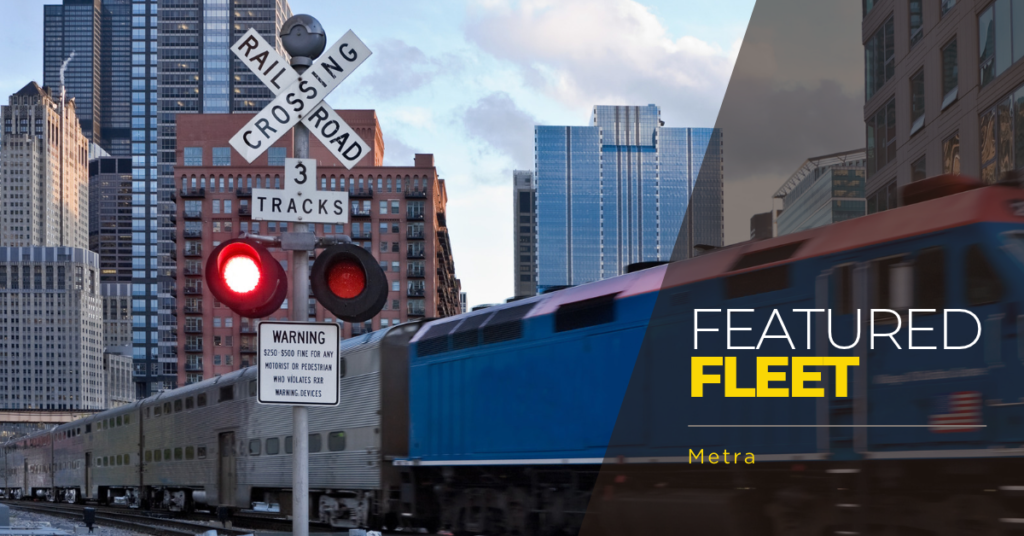
There is a simple reason public transit sits at the heart of cleaner transportation: every full train is a few hundred cars not on the road. A single Metra run can replace hundreds of individual commutes, and with them, the fuel burned and the emissions released by each one. Transit is already clean transportation; it does its work through sheer efficiency of scale.
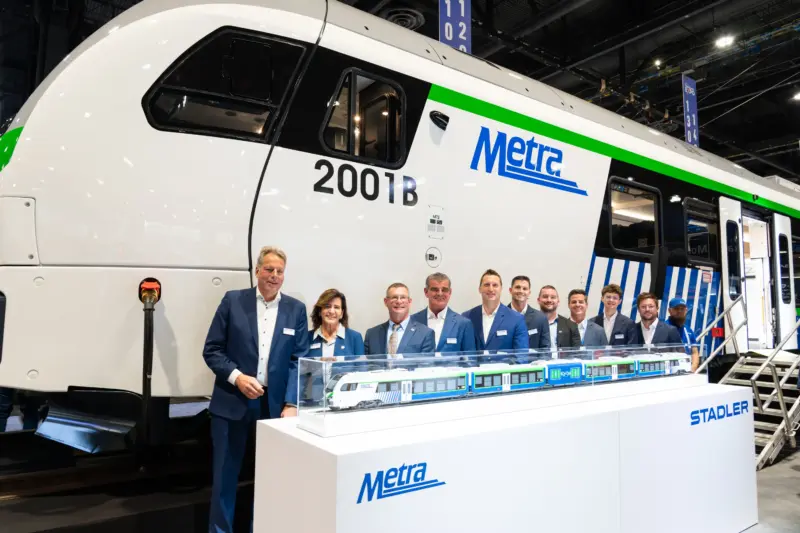
So what happens when you take something already clean and remove the last of its emissions at the source? You get what Metra showed off this month at LaSalle Street Station in Chicago: North America’s first battery-powered passenger trainsets, and a glimpse of what optimal clean transportation can look like.
Metra will take delivery of eight four-car trainsets, with an option for eight more, the first expected to enter service in 2028 after about a year of testing. They will begin on the Beverly Branch of the Rock Island Line, running the 16.4 miles between LaSalle Street and Blue Island. Built by Stadler on its FLIRT platform—short for Fast Light Innovative Regional Train—each set draws its power from onboard lithium-ion batteries rather than a diesel locomotive or continuous overhead wires.
The engineering is as practical as it is clean. The batteries recharge from existing 480-volt cabling already in place at Metra’s yards and terminals, from dedicated charging infrastructure, and from the energy recovered through regenerative braking every time the train slows. That matters because it sidesteps the enormous cost of stringing overhead catenary along an entire corridor, making battery power a realistic option on routes where full electrification would be impractical or prohibitively expensive.
Riders will notice the difference, too. The single-level cars offer low-level boarding and lifts for ADA accessibility, open gangways that let passengers move freely from car to car, and seating for 208, along with bike and luggage racks, USB outlets, passenger-information displays, and two accessible restrooms per set. The ride is quieter as well as cleaner—no idling diesel, no exhaust at the platform.
It is fitting that much of the purchase is backed by a federal Congestion Mitigation and Air Quality Improvement grant—nearly $170 million allocated through the Chicago Metropolitan Agency for Planning—because clean air is exactly the point. This is a project that pays a double dividend: the mode shift that transit delivers by taking cars off the road, layered with zero-emission propulsion that removes the diesel entirely. Fewer cars on the highway, and a cleaner train carrying the people who left them behind.
For Illinois, there is a leadership story here as well. These will be the first battery trainsets to carry passengers anywhere in North America, and Metra expects them to enable more frequent, all-day service and smoother connections with CTA and Pace, the kind of reliable, convenient service that persuades more riders to leave the car at home in the first place. Zero-emission equipment and better service, each reinforcing the other.
At IACT, we talk often about matching the right clean-transportation technology to the right job. Here is a case where the job—moving a lot of people, cleanly, along an existing corridor—and the tool fit together just about perfectly. Transit was already the cleaner choice. With battery power on the rails, it becomes the optimal one.

Dr. Ann Schneider became IACT’s chair in 2026, bringing 36 years of professional experience in public finance, public policy, and solutions development and 18 years of executive-level transportation policy experience to the role. Now a transportation policy consultant, Dr. Schneider has helped clients secure nearly $357 million in grant funding.