

Introducing Tim Milburn — Founding Partner of Green Ways 2Go
Since 2011, Tim has been active in clean transportation projects and consulting work, as a Partner at Green Ways 2Go. Project activities started with developing and deploying alternative fuel projects, including turnkey projects for EV charging, compressed natural gas, and propane autogas. Since 2016, most of his efforts have been focused on transportation electrification for private and public fleets, multifamily dwellings, and commercial operations. Prior to GW2G, he worked as a field engineer, design engineer, engineering manager, and business unit vice president for ABB, and a product design process consultant. Tim has been the technical advisor for the Metropolitan Mayors Caucus‘ EV Readiness Program since 2019 and co-developed the program.
For Tim, IACT and its predecessor, CACC, have provided an excellent means of networking with vendors and prospective customers, as well as providing opportunities to help educate and learn about the clean transportation universe. IACT continues to provide information and access to programs that are otherwise challenging to find, notably active and future policies and incentives and introduction to emerging technologies.
Perspective: Smart Integrated Energy Ecosystems for Transportation Electrification
Transportation electrification provides a unique set of opportunities compared to traditional forms of transportation. Historically, fossil fuel vehicle designs often evolve from year to year by updating some existing features and capabilities or reacting to regulations.In contrast, much of today’s EV design process starts with a clean sheet of paper, especially related to propulsion, controls, communication, design features, materials, and more. EVs are designed as a system to include new materials, aerodynamic features, lightweighting, battery thermal management systems, and digital controls that can communicate and react with the vehicle plus the internet, the grid, homes, and businesses in ways that traditional vehicles have not.
The fuel is electricity, which is ubiquitously available. EVs can basically recharge anywhere near a grid if the investment in EV charging stations and infrastructure is supported. In general, if a location has electricity, there is access to the internet. This means that EVs can “talk” to a wide range of devices, networks, and systems. This allows the financial side of energy to be integrated into the combination of the driver, smart devices, vehicles, EV charging stations, the grid, facilities, the internet, autonomous vehicles (AVs), and artificial intelligence. Digitization adds the ability to optimize the vehicle’s performance, in terms of partial to fully-autonomous operation and preventive maintenance; smart safety features, such as multiple camera systems, sensors, machine learning, visual and audible alerts, and automatic braking; and integration with call, text, and email systems for communication, energy management, and more.
EV and fossil fuel vehicles now integrate similar smart safety and communication solutions. There are few gasoline car models with partial driving automation (Level 2 of 5 on SAE’s driving automation scale). Development of fully autonomous vehicles (Level 4 and 5 of 5) are almost exclusively EVs. Early AV adopters are mainly opting for EVs as they have lower operating costs, lower maintenance costs, and better operating efficiencies. Many of these AVs are high-mileage applications (e.g. Waymo fleets) where the incremental fuel and maintenance costs are major contributors to attractive ROIs. In addition to providing reduced tailpipe emissions, EVs are part of an integrated energy and communication paradigm, leading the world of transportation into the future.
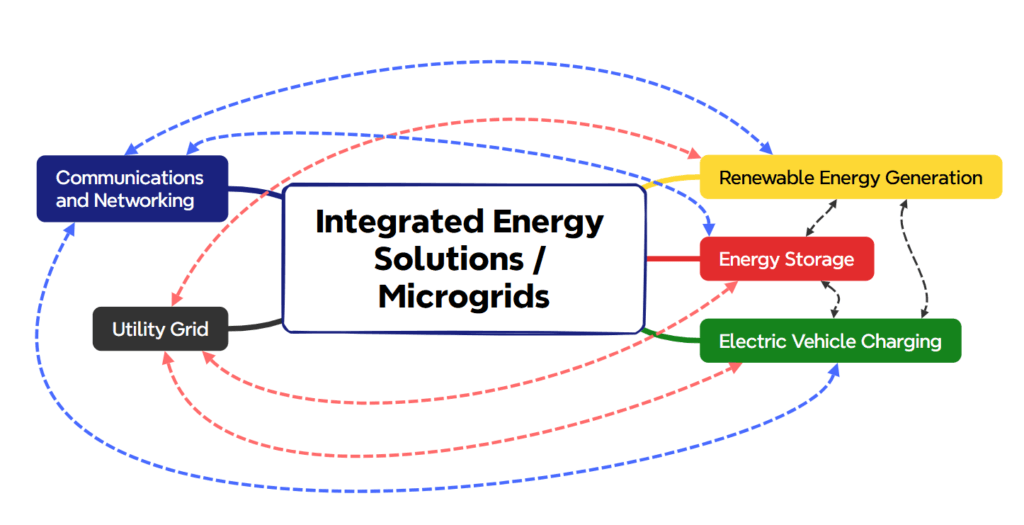
As this ecosystem advances, the natural tendency is to do more. For individual vehicle owners and groups of vehicles (fleets, multiple family dwellings, parking lots), the technology is being deployed and advanced to integrate EV charging with renewable energy generation (primary solar PV), so EVs can be “charged by the sun” and offset operating costs. Adding battery energy storage systems (BESS) provides the ability to store or discharge energy based on user-defined algorithms. BESS can be recharged from the grid or from renewable power generation. For those paying time variant electricity rates or monthly peak demand charges, costs can be minimized by managing when and how much energy is fed to or consumed from the BESS or the grid or directly provided by renewable power sources.
When utility rates are high (peak demand periods, the BESS can provide some or all the power for recharging EVs and/or powering the host facility, thus reducing costs.
Technologies are now available that can manage and optimize (“arbitrage”) these tradeoffs within the sub-systems and integrated energy management systems as a whole. Electricity can be managed bi-directionally (“V2X”) between EVs and the grid, homes, and businesses. Communications between participants allow usage and other information and financial transactions to be managed. EVs can communicate with traffic signals, road side smart devices, and even pedestrian’s ear buds. Applications keep coming through innovation. Society’s future needs, available technologies, and “Internet of Things” solutions have come together to provide a smart, scalable, and expandable set of interconnected solutions. The figure below shows the simplified logic of this ecosystem
This integrated approach further contributes to a facility’s resilience by having multiple power sources to mitigate power outages while continuing to reduce greenhouse gas emissions.
Illinois and other states have enacted policies to support and facilitate the growth of such technology markets in the form of incentives, low interest rate loans, education, and workforce development. The more integrated approaches succeed through policy, innovation, and growth in production, the lower the costs. The financial gap between a fossil fuel vehicle and EV has largely been closed by passenger vehicles—in 2021, EVs cost 50% more than a fossil fuel vehicle (without incentives); this gap has since been greatly reduced, with EVs only carrying a 15% premium in 2026. ROIs based on incremental savings in fuel and maintenance costs can easily justify many EV investments, and the same vehicle cost reduction cycle is anticipated for larger vehicles. In the meantime, some incentives are available to offset the CapEx differentials for mid and large sized EVs.
Illinois’ Clean and Reliable Grid Act (PA 104-0458) (“CAGR”) passed in late 2025. The Illinois EPA and other agencies are tasked with the implementation of the act’s elements, which are being defined in 2026 for a rollout of programs and policies thereafter. Interested parties should check out the Public Act 104-0458 Implementation webpage.
This new ecosystem is no longer something on a future horizon—this is happening now.

Tim Milburn has been a founding partner of Green Ways 2Go since 2011, bringing more than 30 years of experience in the energy and environmental sectors. He supports municipalities in advancing transportation electrification and currently serves as a Project Advisor for the Metropolitan Mayors Caucus EV Readiness program, where he develops research and outreach materials.