

As states, fleets, utilities, and technology providers work to reduce transportation emissions, one sector continues to present unique challenges: freight transportation. Medium- and heavy-duty trucks move the goods that power our economy, delivering everything from food and consumer products to construction materials and industrial equipment. At the same time, these vehicles account for a disproportionate share of transportation-related emissions due to their size, fuel consumption, and demanding duty cycles. While passenger vehicle electrification has made significant progress over the past decade, heavy-duty freight remains one of the most difficult transportation segments to decarbonize.
Unlike passenger vehicles that can often charge overnight at home or work, commercial trucks operate under a very different set of requirements. Freight fleets depend on high vehicle utilization, reliable fueling infrastructure, fast turnaround times, and large amounts of energy to keep goods moving efficiently. These operational realities make the transition from diesel to battery-electric trucks far more complex than simply replacing one vehicle with another.

Additionally, discussions about transportation electrification often focus on the vehicle itself, with questions about range, charging times, and purchase costs dominating the conversations. While these factors remain important, many fleet operators are learning that the truck itself is only one piece of a much larger puzzle. Successfully operating electric freight vehicles requires reliable charging infrastructure, access to financing, maintenance and service support, route planning capabilities, freight demand, and assistance navigating evolving regulations. Fleets are often left to connect all the pieces themselves.
WattEV: Reimagining Freight Electrification
Many companies working to accelerate freight electrification focus on one specific challenge: Greenlane primarily builds and operates charging infrastructure; manufacturers such as Tesla produce electric trucks; fleet leasing companies like Element Fleet Management help carriers finance vehicle purchases; and logistics providers like DHL Supply Chain move freight but typically do not own charging networks.
WattEV is attempting to take a different approach. Founded in 2019 and based in Long Beach, California, WattEV was created to accelerate the transition of heavy-duty freight transportation from diesel to electricity. Rather than focusing solely on vehicles or charging infrastructure, WattEV has built a business model designed to address multiple barriers to electrification simultaneously, and was recently named a BloombergNEF’s 2026 Pioneer for decarbonizing shipping and heavy-duty transport.

To accomplish this, WattEV functions like several businesses under one umbrella. The company develops and operates heavy-duty truck charging depots, electric truck fleets, truck leasing programs, freight transportation services, charging infrastructure projects, and fleet support operations.
This combination makes WattEV difficult to categorize using traditional industry definitions. It is not simply a charging company, a truck leasing provider, or a freight carrier. Instead, it combines elements of all three into a single platform designed to simplify the transition to electric trucking. Its comprehensive approach has led many industry observers to describe the company as one of the most vertically integrated electric freight companies in North America, with key differences in its offerings for both carriers and shippers compared to others.
Truck-as-a-Service (TaaS)
Traditionally, fleets interested in freight electrification must make substantial upfront investments in vehicles, charging equipment, and operational planning. These costs can be particularly challenging for smaller carriers and owner-operators. WattEV’s Truck-as-a-Service (TaaS) model allows fleets to gain access to Class 8 electric trucks, charging services, maintenance support, telematics systems, and operational assistance through a bundled service offering. Rather than purchasing all of these components separately, carriers can access them through a subscription-style arrangement. This reduces upfront capital requirements and allows fleets to gain experience with electric trucking while minimizing financial risk.
In May 2026, WattEV announced plans to deploy 370 Tesla Semi trucks, a move described as the largest single electric truck deployment in California. More than 300 of those vehicles are expected to support freight operations connected to the Port of Oakland.
Public, Heavy-Duty Charging Infrastructure
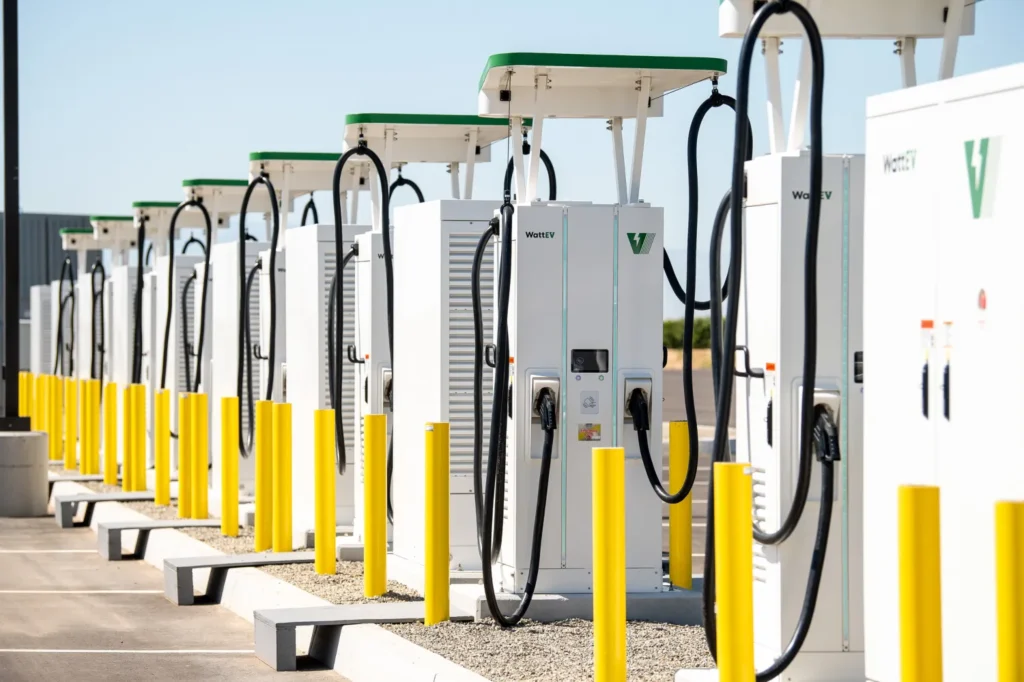
Many fleet electrification projects rely on private charging depots built specifically for one fleet’s use. While effective in certain situations, that model can be expensive and may not be practical for every carrier. Instead, WattEV is focused on public heavy-duty charging infrastructure, developing a network of truck charging hubs along major freight corridors throughout California. These facilities function more like truck stops than traditional fleet depots and are designed to serve multiple users. The company has developed charging locations near major freight centers including the ports of Long Beach and Oakland, as well as inland logistics hubs such as San Bernardino and Bakersfield.
Focus on Freight Operations
While some charging providers generate revenue primarily through electricity sales, WattEV also earns revenue through freight transportation services and vehicle leasing. The company has accumulated millions of freight miles operating electric trucks in real-world drayage and regional-haul applications. This operational experience provides valuable insight into charging schedules, route planning, vehicle performance, and infrastructure needs. Rather than building infrastructure based solely on projections, WattEV is actively participating in the freight market it hopes to transform.
Megawatt-Charging Strategy
As battery-electric trucks continue to evolve, charging speed will become increasingly important. Long charging times can reduce vehicle utilization and negatively affect fleet economics. Perhaps one of the most forward-looking elements of the company’s strategy is its investment in Megawatt Charging System (MCS) technology, with charging rates reaching up to 1.2 megawatts for compatible trucks.
WattEV believes that charging times of roughly 30 minutes for hundreds of miles of range will be essential for widespread Class 8 truck adoption, particularly for regional and long-haul applications. The company’s investments in both CCS fast charging and MCS reflect a broader industry understanding that infrastructure must continue advancing alongside vehicle technology. Freight transportation follows established routes, and strategically placing charging infrastructure where freight already moves may prove more effective than attempting to build entirely new transportation patterns.
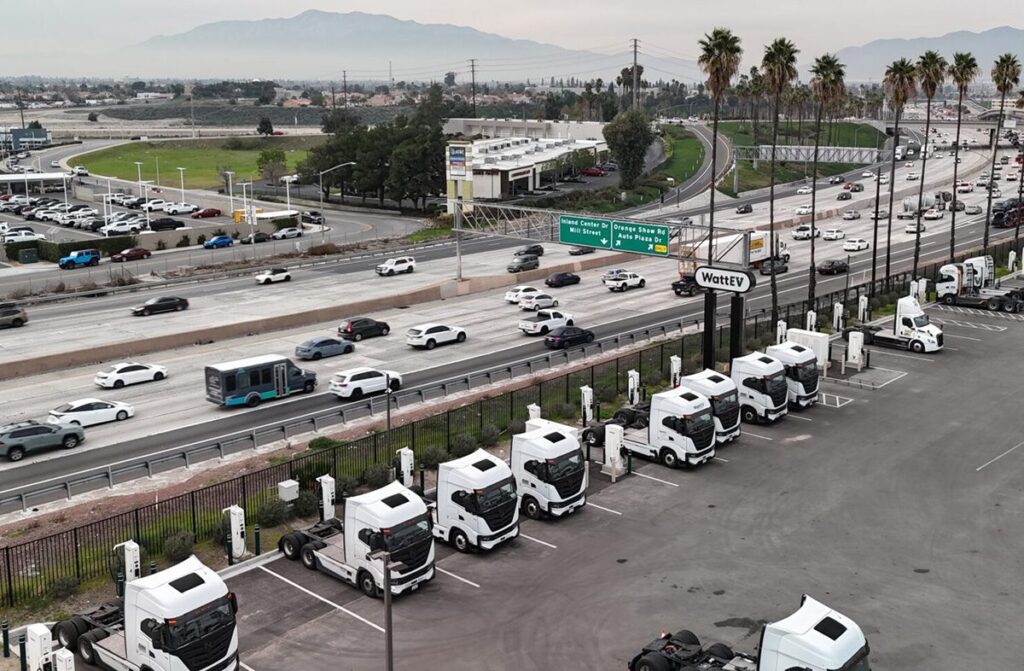
In early 2026, WattEV expanded its San Bernardino depot to 11.5 megawatts of capacity, enabling it to charge as many as 200 electric trucks per day.
Carrier-Focused Business Model
Another important aspect of WattEV’s model is its focus on carriers and owner-operators that may not have the resources, expertise, or real estate necessary to pursue electrification on their own. Many charging developers target large fleet owners or site hosts, but WattEV seeks to remove as many barriers as possible for smaller operators by providing a turnkey solution. By combining vehicles, charging, maintenance, and operational support into a single offering, the company is attempting to make electric trucking accessible to a wider range of businesses.
Lessons for the Future of Freight Electrification in Illinois
Although WattEV operates in California, it plans to expand nationwide. Whether it be WattEV or a similar venture, the challenges addressed are equally relevant in Illinois. With its extensive interstate network, rail intermodal facilities, distribution centers, and major freight hubs, Illinois is well positioned to benefit from similar approaches to freight electrification. WattEV’s model demonstrates that success requires more than electric trucks alone. Reliable charging infrastructure, financing solutions, operational support, and strong collaboration among fleets, utilities, manufacturers, policymakers, and industry organizations are all essential.
WattEV’s approach highlights the importance of reducing barriers to adoption through shared infrastructure, innovative business models, and strategic partnerships. As Illinois continues advancing clean transportation, WattEV shows that the challenge is not whether electric freight vehicles can work—it is how to create the ecosystem necessary for widespread adoption.

Whitney began working with IACT in 2023. With a degree in English and a minor in Art, Whitney has worked as both a newspaper reporter and a digital marketing and events manager, bringing 8 years of marketing and content creation experience to IACT. Whitney is passionate about nature and preserving the environment, including solutions to cleaner air and greater sustainability, and is a former Chicago resident.